
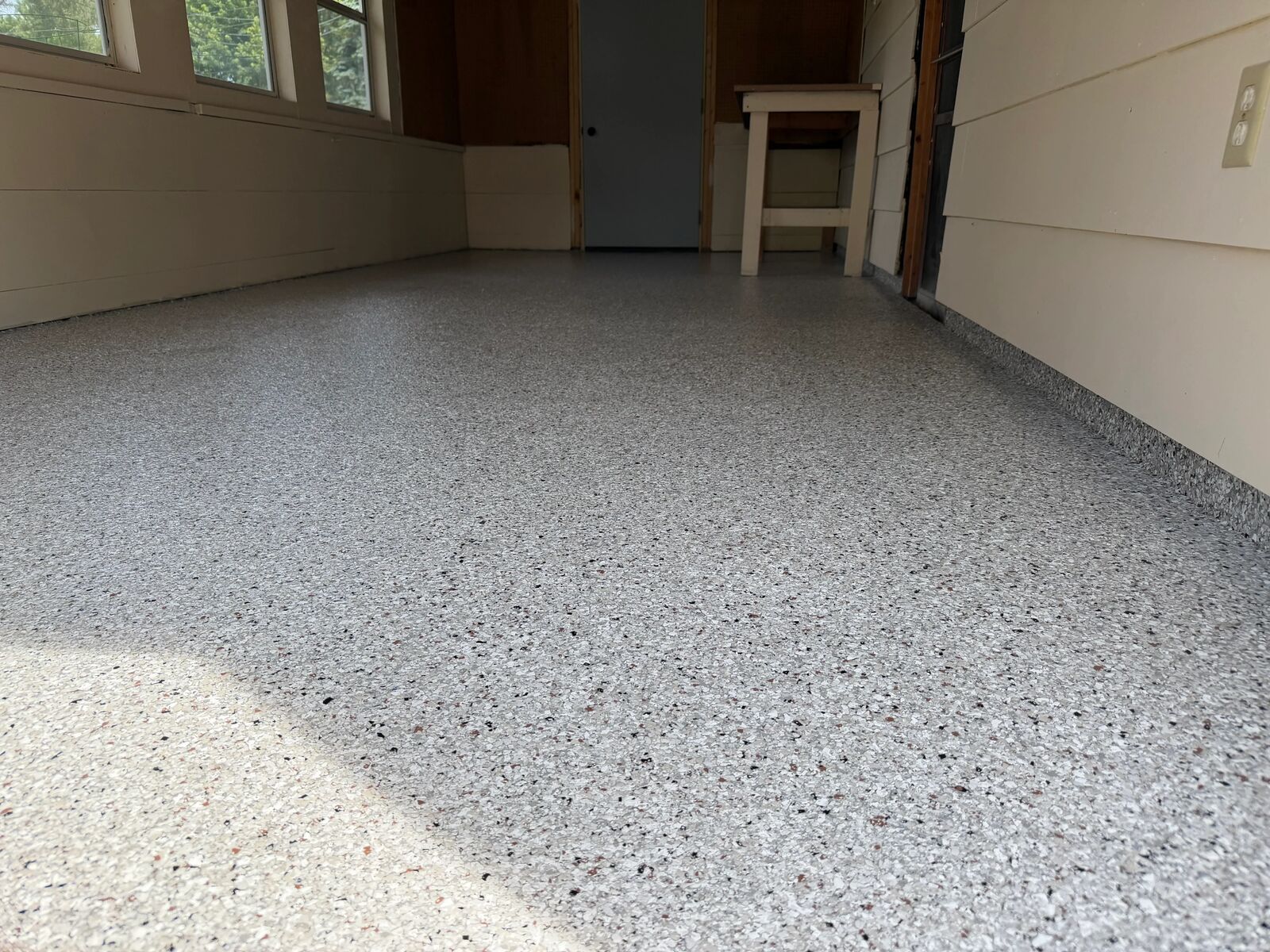
Published third-party ranges put professional concrete coatings at about $4 to $12 per square foot installed. On a 1,200-square-foot pole barn slab that works out to roughly $4,800 to $14,400. Barn slabs vary far more than garage floors, so every project is quoted on site and estimates are free.
What does a pole barn floor coating actually cost?
Independent cost guides are the honest starting point. HomeGuide lists polyaspartic floor coatings at roughly $5 to $12 per square foot installed. An Indiana-specific directory puts garage floor coating at $4 to $10 per square foot in this state. Those numbers are for garages, but they are the closest public benchmark to what a barn floor costs.
Run that against real pole barn sizes and you get a usable range. A 30x40 barn is 1,200 square feet, so roughly $4,800 to $14,400. A 40x60 is 2,400 square feet, so double that. The spread inside those numbers is almost entirely slab condition, which is why we do not quote a barn over the phone.
Every project is quoted on site and estimates are free. We walk the slab, look at the cracks, check for pitting and soft spots, and give you one number before anything starts.
Why pole barns price differently than garages
Square footage is the obvious one. A two-car garage is 400 to 500 square feet. Pole barns around Elkhart, Wakarusa and Warsaw regularly run three to six times that, and material cost scales right along with the floor.
The bigger variable is the slab itself. A lot of barn floors were poured years ago, never sealed, and have spent every winter since taking on moisture, equipment traffic and road salt off trailers and tractors. Garage slabs are usually in better shape because they are smaller, newer and under a conditioned roof.
That means prep is a larger share of a barn quote than a garage quote. If you get two bids that are far apart, the difference is usually how much repair one of them planned to do and the other one did not. Our floor prep and concrete repair work is included rather than quoted as an extra later.
What is included no matter the size of the barn
Every installation starts with diamond grinding the full slab so the coating has a profile to bond to. We vacuum the dust with HEPA-filter vacuums as we go. Some dust still gets airborne in a space that size, and we clean that up before any top coat goes down.
Then the repair work. Cracks get cut open and filled with a two-part repair material, pitting gets filled, and once that cures we grind it back down smooth. We do not coat over a crack and hope it holds.
After prep, a shop floor system gets a polyurea base coat with sand broadcast into it, then a clear polyaspartic top coat that seals everything in. That is the same system in a 900-square-foot barn and a 3,000-square-foot one. The size changes the price, not the process.
Why a pole barn gets sand instead of flake
Decorative flake is what we put in garages and finished spaces where the look matters. In a working barn, traction matters more. Broadcasting sand into the polyurea base leaves a surface with grip under boots that are wet with snowmelt, under hand trucks, and under equipment tires.
Sand also hides working wear better than a decorative flake blend does. A barn floor takes dropped tools, dragged pallets and dirt tracked in off the drive, and a sand-finished floor reads as a work surface rather than a showroom.
If part of your barn is finished living or hobby space, it is reasonable to split the job. We cover the tradeoff in more detail in our post on choosing between a flake floor and a shop floor.
Can you coat an unheated barn in cold weather?
Yes, and the difference shows up in cure times rather than in whether the job can be done. In warmer weather it is 24 hours to walk on the floor and 72 hours to drive on it. In colder weather it is 48 hours to walk on and 96 hours to drive on.
For a pole barn that is the scheduling question, not a technical one. Four days before equipment goes back on the slab means your tractor, mower, trailer or side-by-side needs somewhere else to sit for most of a week. Plan the storage before you plan the install date.
We would rather tell you 96 hours up front than promise you a one-day turnaround and then watch tires mark a floor that was not ready. Our cold-weather cure times post walks through how temperature affects the schedule.
What pushes a pole barn quote higher
Heavy pitting across a large area is the most common one. Filling and regrinding pitting on 2,000 square feet is real labor, and a bid that ignores it is not cheaper, it is just incomplete.
Deep or wide cracking is the second. Cutting open and filling a few hairlines is routine; a slab with long structural cracks and movement takes more material and more time. Large unsealed areas that have absorbed oil and moisture for years also need more grinding before the base coat will bond the way it should.
Access matters too. If the barn is full, someone has to clear it. We will tell you what has to move at the estimate so there is no surprise on install day.
How to compare two pole barn quotes
Ask both contractors what is actually included in the prep, what they do with the cracks, what the base coat and top coat are, and what the cure times are at the temperature you are installing in. If one quote is thousands lower, the answer is almost always in those four items.
Also ask whether the per-square-foot price covers the whole slab or only the area they plan to coat. Barns often have a section that stays bare, and that changes the math. We put together a longer list in how to compare garage floor coating quotes, and the same questions apply to a barn.
We are currently running $500 off installation. Estimates are free. Call Jonathon at (574) 400-3199 or use the contact page and we will come look at the slab in Elkhart, Wakarusa, Warsaw or anywhere else in our service area.
Frequently asked questions
How long before I can park equipment on a coated barn floor?
In colder weather it is 96 hours before anything drives on it, and 48 hours before you walk on it. In warmer weather those drop to 72 hours and 24 hours. Plan on having somewhere else to store equipment for that window.
Do you coat barn floors in the winter?
Yes. Cold weather extends the cure times to 48 hours to walk on and 96 hours to drive on, but the installation itself still goes forward. We will tell you the exact schedule before we start.
What happens to the cracks in an old barn slab?
After diamond grinding, we cut the cracks open, fill them and any pitting with a two-part repair material, then grind that back smooth once it cures. That repair work is included in every installation, not billed as an add-on.
Can I coat only part of my pole barn?
Yes. Plenty of barns get the working bay coated while storage or equipment areas stay bare. Tell us what you want covered at the estimate and the quote reflects that square footage.
Will a sand finish be too rough to sweep?
No. The sand broadcast is there for traction under boots and equipment tires, and the clear polyaspartic top coat seals it into a surface you can sweep, blow out or hose down.