
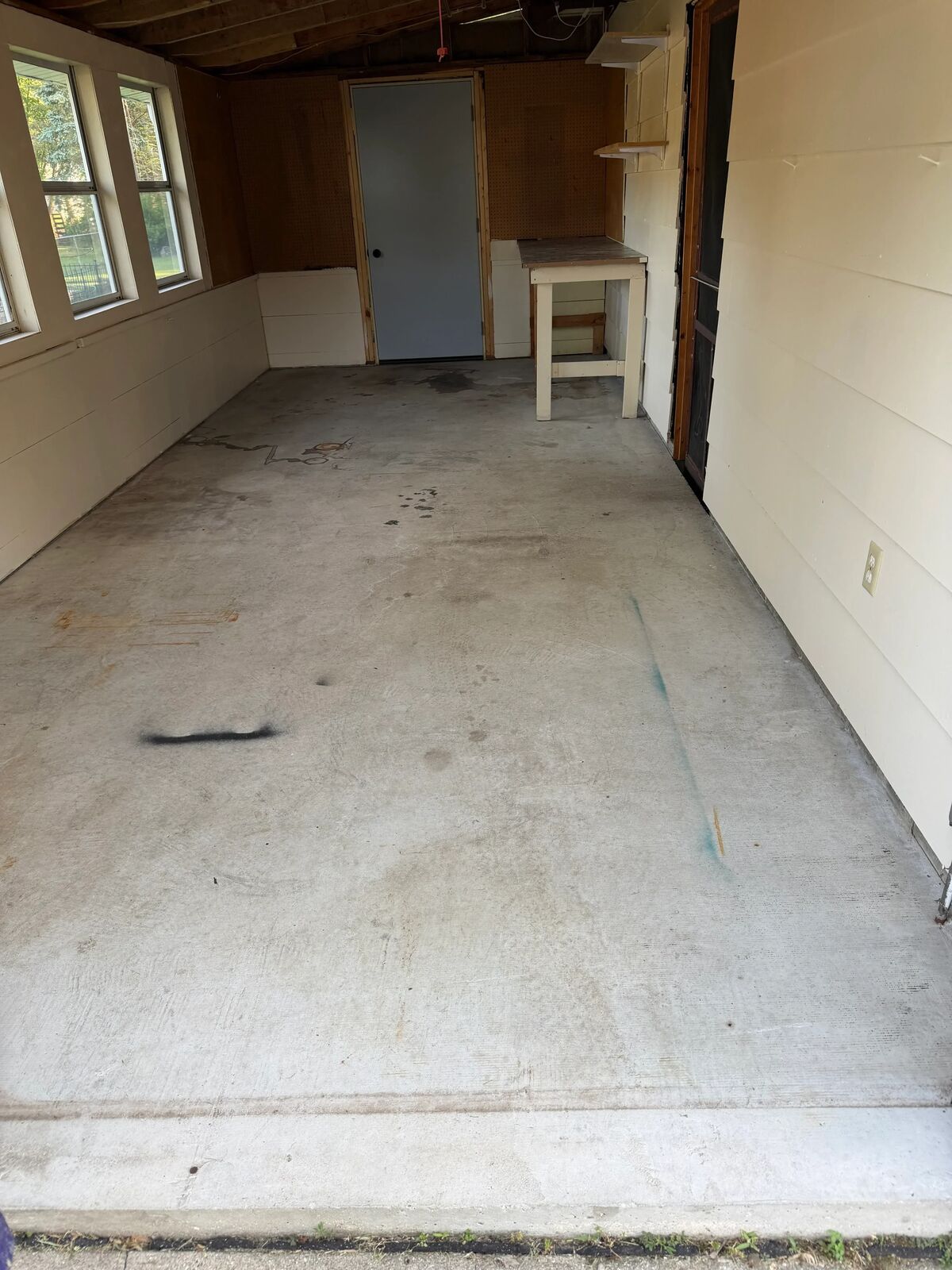
Compare quotes on seven things: what prep is included, how cracks and pitting get repaired, the exact base and top coat chemistry, walk-on and drive-on times by temperature, dust control, whether the estimate is free and done on site, and who performs the work. Price alone hides all seven.
Why two quotes for the same garage can be thousands apart
Most homeowners in South Bend and Mishawaka collect two or three quotes, see a spread, and assume the cheap one is the same floor for less money. Usually it is not. The spread is almost always hiding a difference in prep, in the products going down, or in who is actually holding the grinder.
Coating quotes are hard to compare because nobody writes them the same way. One says "epoxy garage floor, two coats." Another says "polyurea base, polyaspartic top." Neither tells you whether the slab is getting ground, whether the cracks are getting cut open, or how long your cars live in the driveway.
Here are the seven questions I would ask any coating contractor, including me. Ask all three bidders the same seven and the real differences show up fast.
1. What prep is included — is diamond grinding in the price or an add-on?
Prep is where coatings fail. A coating bonds to the concrete profile, not to the smooth, sealed surface your slab has now. If the floor isn't mechanically profiled, the coating is sitting on top rather than locked in.
Ask straight out: is the floor diamond ground, acid etched, or just cleaned? Is grinding included in the number on the page, or is it a line item that appears later? Get the answer in writing.
Every floor we install gets diamond ground first, with the dust vacuumed up before anything is applied. It is part of our floor prep and concrete repair work, not an upsell.
2. How are cracks and pitting handled, and with what material?
Walk the garage with the estimator and point at every crack and every pitted spot. Ask what happens to each one and what material goes in it. "We'll fill them" is not an answer — caulk fills a crack too, and it will telegraph through your new floor by spring.
Our process is to cut the cracks open after grinding, fill the cracks and the pitting with a two-part repair material, then grind that repair back down smooth once it has cured. That order matters: fill first, cure, then grind flat, so the patch sits level with the slab instead of standing proud of it.
If you want the long version, I wrote it up in our crack and pitting prep process.
3. What exactly are the base coat and the top coat?
"Epoxy" has become a generic word for any garage floor coating, the way people say Kleenex. Ask for the actual chemistry of each layer, because the layers do different jobs.
We install a polyurea base coat. On a decorative flake floor we broadcast biodegradable, nontoxic vinyl flake into that base; on a shop floor we broadcast sand instead. Both get sealed under a clear polyaspartic top coat, which locks everything in and brightens the color of the flake.
In my experience these systems hold up better than epoxy and flex with the slab's movement rather than fighting it, and the polyaspartic top coat is UV stable so sunlight through an open door is not a problem. That's my read from doing this work, not a lab result — so ask every bidder what their product is and what it's rated for, and compare the answers.
4. How long until I can walk on it and drive on it — and does the weather change that?
This is the question that separates honest quotes from sales pitches in northern Indiana. Cure is a chemical reaction, and reactions slow down when it is cold. A contractor who gives you the same cure time in January as in July either isn't thinking about it or isn't telling you.
Our numbers: in warmer weather, 24 hours to walk on and 72 hours to drive on. In colder weather, 48 hours to walk on and 96 hours to drive on. January in South Bend averages a low around 20°F and a high around 33°F, so winter installs land on the longer end — plan where the cars go for four days.
More detail on timing is in how long before you can drive on a coated floor.
5. How is dust controlled, and who cleans it up?
Diamond grinding a two-car garage makes a remarkable amount of concrete dust, and your garage probably connects to your house. Ask what equipment catches it and what happens to whatever escapes.
We grind with vacuums running HEPA filters that pull up most of the dust at the source. Some still gets airborne — anyone who tells you otherwise hasn't ground a floor — and we clean that up before the top coat goes down, because dust in a wet coating stays there permanently.
If a bidder has no answer to this question, ask who is wiping down your water heater and your storage shelves afterward.
6. Is the estimate free, on site, and is anything quoted sight unseen?
A number given over the phone from square footage alone is a guess. The condition of your slab — how much pitting, how many cracks, whether there is old coating or sealer to grind off — is most of the labor.
Our estimates are free and we come look at the slab. We also have $500 off installation running right now. Every floor is quoted on site after we see what we're working with.
For general context on what this work costs nationally, HomeGuide puts professionally installed polyaspartic garage floor coating at $5 to $12 per square foot, or roughly $2,000 to $6,900 for a two-car garage. Treat that as a sanity check on the quotes in your hand, not as your price.
7. Who is actually doing the work on your floor?
Some of the companies bidding your garage are national brands running crews through the region. That isn't automatically bad, but you should know whether the person who sold you the floor has anything to do with installing it, and who you call if something needs attention later.
C&J is a newly established company, and I say that plainly rather than hiding it. Between us there are 16 years of experience coating floors, and my name is on the quote. I'm Jonathon Conway, and you can see finished work on our gallery page.
Two red flags worth repeating: a quote with no prep detail at all, and a cure time that doesn't change with the temperature. Either one means you're comparing a price to a price instead of a floor to a floor. Call (574) 400-3199 or use our contact page for a free on-site estimate.
Frequently asked questions
Should I just pick the lowest quote?
Only after the seven questions above have the same answers across bidders. If the cheap quote skips diamond grinding or leaves cracks unrepaired, you are buying a shorter-lived floor, not a discount.
Can a coating be installed in winter in Michiana?
Yes, in a controlled garage. Plan on the cold-weather cure window: 48 hours before walking on it and 96 hours before driving on it. Ask any contractor to put their winter cure times in writing.
Do I need to move everything out of the garage first?
Yes. The floor has to be completely clear for grinding and coating, including shelving units that sit on the slab. We'll go over what needs to move when we come out for the estimate.
What should the written quote actually list?
At minimum: grinding method, crack and pitting repair with the material named, base coat and top coat products, flake or sand broadcast, total square footage, and walk-on and drive-on times. If any of those are missing, ask for them before you sign.
Does C&J serve towns outside South Bend?
Yes. We cover Mishawaka, Elkhart, Warsaw, Valparaiso and several Michigan towns including Niles, Kalamazoo and Three Rivers. Our service areas page lists them all.