
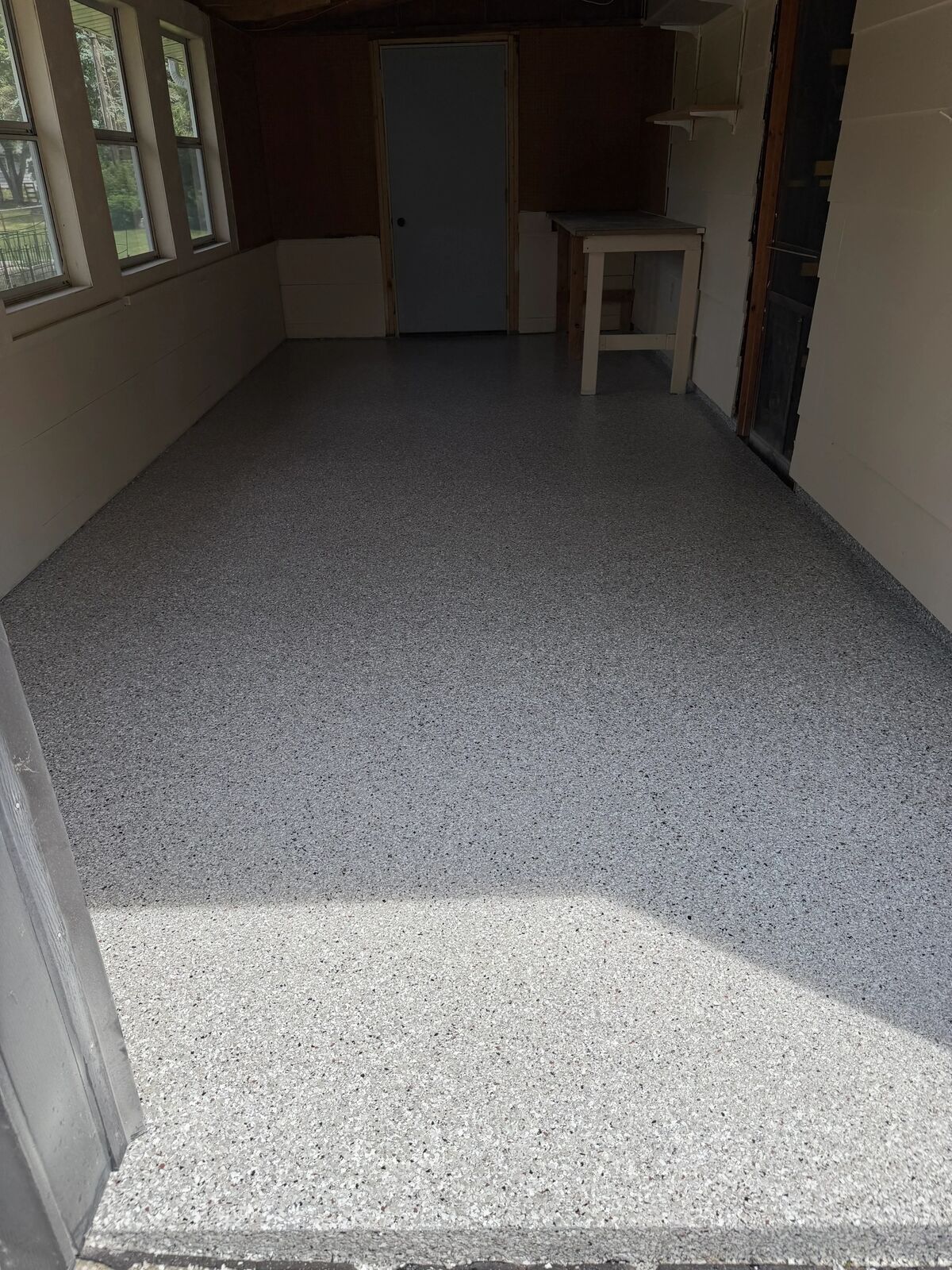
A garage floor coating from us in South Bend is a polyurea base coat with biodegradable, nontoxic vinyl flake broadcast into it, sealed under a clear polyaspartic top coat. Diamond grinding, dust control and crack repair are included. In warm weather you walk on it in 24 hours and drive on it in 72.
What happens before we ever grind anything?
It starts with a free estimate. We come out, measure the garage, and look at the slab itself: how it was finished, where it is cracked, whether there is pitting, how much of it is covered in old sealer or paint, and where moisture or salt stains show up. That walk-through is what tells us how much prep the floor needs, and prep is the part that decides how the finished floor looks.
We also talk about color at that visit. The flake blend sets the whole look of the garage, and it is easier to decide in person with samples in your hand than from a screen. If you want to think it over first, we wrote up how we talk homeowners through it in choosing flake colors for your garage floor.
The last thing we cover is what needs to come out of the garage. The floor has to be empty and swept before we start. Shelving on the walls can usually stay; anything sitting on the slab has to move, including the car.
How does the grinding and dust control actually work?
The first thing we do on install day is diamond grind the entire slab. That opens up the surface of the concrete so the coating has something to bite into, and it takes off old sealers, paint and loose material. Coatings that are rolled over a slick, sealed slab are the ones that come up in sheets later.
We run vacuums with HEPA filters that pull up most of the dust as we grind. We are straightforward about this part: some dust still gets airborne in a closed garage. We clean that up before any coating goes down, because dust trapped under a base coat is a defect you can see forever. There is more detail on the equipment and the sequence in how we control dust during diamond grinding.
What do you do about my cracks and pitting?
After the grind and the vacuum, we go after the damage. Cracks get cut open rather than smeared over — widening them gives the repair material something to hold onto. We fill them with a two-part repair material, and we fill pitted and spalled areas the same way.
Once that material has cured, we grind it back down flush with the slab so the repair is level with everything around it. Only then does the floor get coated.
This is included in every installation we do, not an upsell that appears on the invoice later. You can see the whole sequence on our floor prep and concrete repair page. Older South Bend slabs almost always have something that needs this step, and it is worth asking any company you quote whether their price includes it.
What goes down on the concrete, and in what order?
The base coat is polyurea. It goes onto bare, ground, repaired concrete and it is the layer that bonds to the slab. While that base coat is still wet, we broadcast the vinyl flake into it by hand so the flake sets into the coating instead of sitting on top of it. Our flake is a biodegradable, nontoxic vinyl.
We broadcast heavy, to refusal, so the color is consistent rather than patchy. Once it cures, we scrape and vacuum the loose flake off the surface, which leaves a flat, even bed of color ready for the final layer.
Then comes the clear polyaspartic top coat. It seals the flake in, gives you the surface you actually walk and drive on, and brightens the flake colors noticeably compared to how they look before it goes on. It also gives the floor its texture — the flake bed creates a surface with grip rather than a glassy sheet. If you want the chemistry side of it, we broke that down in what a polyaspartic top coat does.
When do I get my garage back?
This is where we would rather be honest than impressive. In warmer weather, you can walk on the floor 24 hours after we finish and drive on it 72 hours after. In colder weather, those numbers move to 48 hours to walk on and 96 hours to drive on.
Temperature drives the cure, and Michiana gives us a wide range of it. A September install and a January install are not the same job. We will tell you at the estimate which window your project is likely to land in, and we will confirm it on install day based on the actual conditions in your garage.
Driving on a floor before it has cured is one of the few ways to damage a new coating early. If you need the car inside sooner than the schedule allows, plan the install for a week when that is not a problem. More on the cold-weather side is in coating a garage floor in cold weather.
Why choose this system over epoxy?
Our owner, Jonathon Conway, says the system is four times stronger than epoxy and that it flexes with the movement of the slab rather than staying rigid over it. He also points to the polyaspartic being UV stable, which is what matters in a garage where the door spends the summer open. That is his read on the system, and we would rather say so plainly than present it as a lab result we did not run.
What we can point to without any qualifier is what is in the process: the grinding, the HEPA vacuums, the crack and pitting repair, the hand broadcast, and cure times we state up front instead of after the deposit.
C&J CONCRETE COATINGS LLC is a new company with a combined 16 years of experience coating floors behind it. We are not trying to build the biggest coatings outfit in Indiana. We want to put down showroom-style floors in our own community and stay part of it.
Do you coat garages outside South Bend?
South Bend is home base, and we work across Michiana from here — Mishawaka, Elkhart, Wakarusa, Warsaw, Valparaiso and Portage on the Indiana side, and Niles, Dowagiac, Cassopolis, Three Oaks, Three Rivers, Stevensville, Kalamazoo and Portage in Michigan. The full list is on our service areas page.
Estimates are free, and we currently have $500 off installation. Call Jonathon at (574) 400-3199 or use the contact page to get on the schedule. Every garage is measured and quoted on site, because square footage, slab condition and the amount of repair work vary more than most people expect.
If you are comparing bids, read our decorative flake floor systems page and bring the same questions to every company you talk to. Searching garage floor coating in South Bend on Google or through directories like Angi will give you plenty of names — what separates them is prep, materials and whether they tell you the real cure times.
Frequently asked questions
How long does the whole installation take?
The grinding, repair, base coat and broadcast, and top coat are the work itself. What you plan around is the cure: 24 hours to walk on and 72 hours to drive on in warmer weather, 48 and 96 hours in colder weather.
What is the flake made of?
A biodegradable, nontoxic vinyl. It is broadcast into the wet polyurea base coat by hand and then sealed under the clear polyaspartic top coat, which brightens the colors.
Do I need to empty the garage?
The slab needs to be completely clear before we grind, so anything sitting on the floor has to come out, including vehicles. Wall-mounted shelving can usually stay. We will go over this at the estimate.
Will this work on an older, stained South Bend slab?
Usually, yes. Diamond grinding removes old sealers, paint and surface staining, and cracks and pitting get repaired before coating. We confirm the slab is a good candidate at the free estimate rather than guessing from a photo.
Do you have a current promotion?
Yes — $500 off installation, and estimates are free. Call (574) 400-3199 to have your garage measured and quoted on site.