
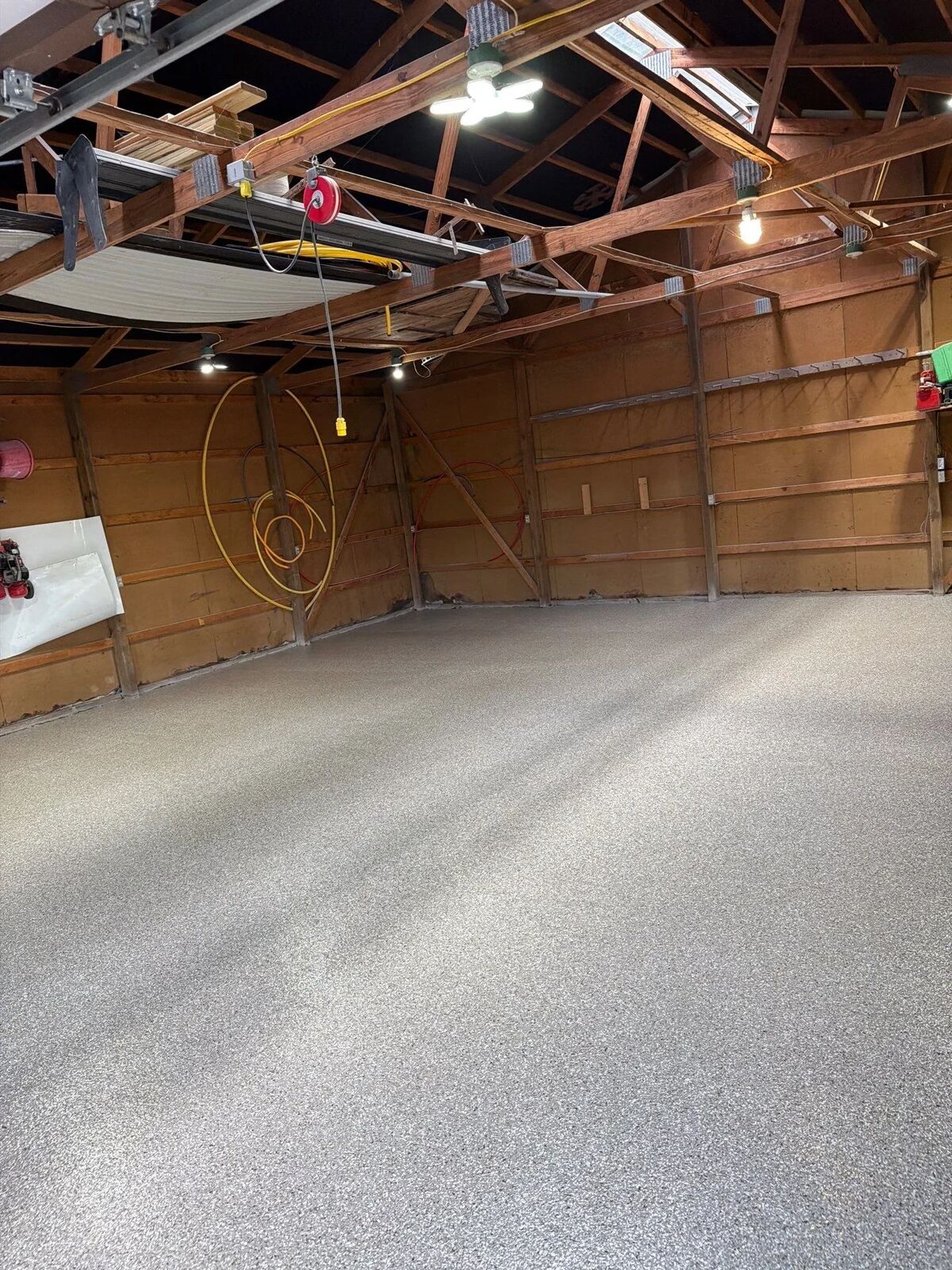
The system is the same in both rooms: a polyurea base coat, a broadcast of vinyl flake, and a clear polyaspartic top coat. What changes is the slab, what the grind uncovers, and the timeline. A basement is conditioned space, so the 24-hour walk-on window usually applies, and with no vehicles there is no drive-on wait.
Is a basement floor coating the same system as a garage?
Yes. We install the same decorative flake floor system in a basement that we install in a garage: a polyurea base coat, a broadcast of biodegradable, nontoxic vinyl flake, and a clear polyaspartic top coat that seals everything in and brightens the flake colors.
Nothing about the product changes because the room is below grade. The chemistry, the build and the finish are identical. People ask this a lot because garages get all the attention online, but this system was always meant for residential spaces too, and a basement is one of the better rooms for it.
What does change is everything around the coating — the condition of the concrete, what we find once we start grinding, and how long you wait before you use the room again.
What stays exactly the same: the prep
Every installation we do, garage or basement, includes the same floor prep and concrete repair. We diamond grind the slab first. That opens up the surface so the polyurea has something real to bond to, and it tells us what the concrete is actually like underneath whatever has been sitting on it.
Then we vacuum the dust. Our vacuums run HEPA filters and pull up most of it, but we will be honest with you: some dust does get airborne. We clean that up before we top coat the floor. In a finished basement we would rather you move or cover anything you care about ahead of the grind, because a basement has more in it than a garage does.
After the grind we cut open any and all cracks and fill them with our 2-part repair material, fill the pitting, and grind that back down smooth once it has cured. That step is not an add-on. It is part of every job we quote.
What's different about a below-grade slab
A basement slab usually has a different history than a garage slab. It has not been taking tire weight, it has not been hit with road salt every winter, and in a lot of Michiana houses it has been under carpet, tile, glue, paint or an old sealer for decades. A garage floor is typically bare and you can read it before you ever touch it.
That means the grind matters more in a basement, because it is often the first time anyone has seen the real concrete. Old adhesive, paint and coatings have to come off. Sometimes the slab underneath is in better shape than the homeowner expected. Sometimes we find cracking or pitting that the flooring was hiding.
There is one thing we will not tell you over the phone, and that is how a particular basement slab will behave with moisture. Below-grade concrete can carry moisture up from the ground, and the amount varies house to house in South Bend, Mishawaka and Elkhart depending on the age of the home, the grading outside and what is under the slab. This is why we come look at it in person before we quote a number, and why we would rather tell you up front that a floor needs something addressed than coat over a problem.
Why the cure timeline is usually easier in a basement
Our cure times are temperature-driven. In warmer conditions you can walk on the floor after 24 hours and drive on it after 72. In colder conditions that stretches to 48 hours to walk on and 96 hours to drive on.
A garage in northern Indiana spends a good part of the year on the cold-weather side of that. A basement does not. It is inside the conditioned envelope of the house, so the warmer-weather numbers apply far more often, even in January. That is a real scheduling advantage if you are trying to get a project done in the off-season.
We will still tell you which timeline applies to your job before we start. If the basement is unheated or the furnace is down, we treat it like cold weather. We would rather give you the longer number and have you walk on a floor that is ready than rush you.
No cars means no drive-on wait
This is the part homeowners usually have not thought about. The 72- and 96-hour windows exist for vehicle traffic. Tires are a different load than feet, and they are the reason the longer wait is there.
In a basement there are no vehicles, so the only window that matters to you is the walk-on window. In most cases that is 24 hours. After that you can be in the room.
For furniture, shelving and heavier items, give it a little more. We will tell you on the day what we would do with your specific floor, and if you want a gym rack, a workbench or a freezer back in place, mention it during the estimate so we can plan the timing around it.
Do flake colors look different in a basement?
They can. The clear polyaspartic top coat brightens the flake colors wherever it goes down, but a basement is usually lit by fixtures rather than daylight through an open overhead door. Warmer bulbs pull color one way, cooler LEDs pull it another, and a darker blend that looks sharp in a bright garage can close a low-ceilinged basement in.
If the room is going to be a living space, a gym or a kids' area, lighter blends generally make it feel bigger and hide less. Flake also breaks up the look of the floor, so small marks and dust show less than they would on a solid color. There is more on picking a blend in our post on choosing flake colors for your garage floor — the same logic applies indoors, just with your lighting in mind.
Bring us into the room with the lights you actually use. It is a two-minute conversation at the estimate and it saves second-guessing later.
When we'd tell you the floor isn't ready
We are not going to coat a slab that is not going to hold the coating. If we see active water coming through, structural cracking that is moving, or a surface that is failing rather than just worn, we will say so and tell you what we would want handled first. That conversation is free and it is better to have it before you spend money.
Most basements are not in that category. Most of them need a thorough grind, some crack and pitting repair, and then they coat like any other floor. Our slab readiness checklist walks through what we look at, and you can run most of it yourself before you call.
Estimates are free, and we are running $500 off installation right now. Call Jonathon at (574) 400-3199 or get in touch through the site and we will come out, grind-test the slab where it matters, and give you a straight answer on what your basement needs.
Frequently asked questions
Can you coat a finished basement floor, or does it need to be an unfinished space?
Either works, as long as the existing flooring comes up and we can get to bare concrete. Carpet, tile, glue and old paint all have to be removed and ground off. In a finished basement we also need room to work and a plan for protecting what stays in the house during the grind.
How long before I can put furniture and shelving back?
You can walk on the floor 24 hours after install in warmer conditions, or 48 hours if the space is cold. For furniture and heavier items we'll give you a specific number for your floor on install day — tell us at the estimate what's going back in the room so we can schedule around it.
Will cracks in a basement slab come back through the coating?
We cut every crack open, fill it with our 2-part repair material, and grind it smooth once it has cured, and the polyurea base will flex with movement in the slab. We can't promise a moving structural crack will never show, which is why we look at the cracks in person before quoting.
Is the flake safe to have in a living space?
The flake we broadcast is a biodegradable, nontoxic vinyl. Once it's sealed under the clear polyaspartic top coat it's locked into the floor. The room will smell during install and cure, so plan on ventilation and on staying out of it through the walk-on window.
Do you install basement floors outside South Bend?
Yes. We cover Mishawaka, Elkhart, Warsaw, Wakarusa, Valparaiso and Portage in Indiana, and Niles, Kalamazoo, Portage, Three Rivers, Stevensville, Three Oaks, Dowagiac and Cassopolis in Michigan. Call (574) 400-3199 and we'll tell you our next available date for your area.